
Junction City Directory Shelves
Junction City city directory research begins with a set of known years, not a claim of a complete run. Catalog leads identify city directories for 1905 and 1912 and Polk issues for 1959 and 1961. No official catalog inspected for the research proved the first issue, final issue, or every year between them. The strongest local collections add newspapers, yearbooks, census indexes, maps, and organization directories around those four leads.
| Collection | Years or run | Where held | Access path |
|---|---|---|---|
| Junction City city directory catalog leads | 1905, 1912, 1959, 1961 | U.S. City Directories/Ancestry and FamilySearch Library leads | Search catalog by exact place and year; verify page access or ask library staff |
| Local newspapers | Library range 1861-2022; overlapping digital runs through 2015 | Dorothy Bramlage Library and Advantage Preservation | Free title, date, keyword, and page-image search where digitized |
| JCHS yearbooks | 1900-2024 listed; no 1918 issue and 1989 missing | Library and Advantage Preservation | Browse by year; cite page image and caption |
| St. Xavier yearbooks | 1928-2004, incomplete | Library and Advantage Preservation | Digital browse where scanned; reference desk for gaps |
| Community Information Directory | Since 2007; more than 350 organizations | Dorothy Bramlage Library, print and PDF | Use the dated edition for civic and organization contacts |
| Kansas census and street indexes | 1855-1925; 1905 index and images | KSHS and FamilySearch | Index, image, and reading-room routes; access terms may vary |
| Sanborn fire insurance maps | 1885 through 1925, with later updates located | KU and Library of Congress | Public map images by edition and sheet |
The collection table distinguishes a city directory from its companions. Newspapers can explain a move or business. A census can show a household. A map can show a building. None should be mislabeled as a directory entry.
Junction City Directory Year Leads
The 1905 and 1912 Junction City titles appear in a directory finding aid, while Polk’s Junction City City Directory is cataloged for 1959 and 1961. These are precise search targets. Enter the place, year, surname, street, or business in the FamilySearch catalog, then check whether the item is online, restricted to a participating location, or only described in the catalog.
No page-level entry from those issues was open in the unattended source inspection. Do not invent a name, address, symbol, publisher detail, or continuous date span. Ask the Dorothy Bramlage reference desk to check local holdings and access terms. A clean request names one title, one year, a surname spelling, and a likely street.
Catalog limit. A title record proves that an edition is described or held. It does not prove that the full Junction City city directory can be viewed from home.
Decode a Junction City Entry
A verified page image must control the reading. City directories often print compact facts, but the exact symbols can change by publisher and year. Photograph or save the title page, publication year, page number, and abbreviation key before transcribing a Junction City line.
| Name | Record surname, given name or initials exactly as printed; search married and maiden variants in companion sources. |
|---|---|
| Role or trade | Capture an occupation or business only if it appears on the page; do not infer it from a later source. |
| Street line | Preserve the house number, street spelling, and any residence marker exactly. |
| Household notation | A spouse, widow, boarder, or householder mark is edition-specific and must be checked against the key. |
| Edition citation | Save publisher, year, page, image location, and the date accessed. |
Research expectations include names, addresses, business roles, phone numbers in some telephone editions, and household clues in some volumes. Those expected fields are not proof that all Junction City issues contain them.
- Criss-cross directory
- A later directory section organized by street and house number. No exact open Junction City run was verified.
- Householder index
- An index focused on the named person associated with a household, subject to the publisher’s rules and omissions.
- Abbreviation key
- The edition’s own list of shortened terms and marks. It is the safest way to decode a line.
Junction City Library Archive
Dorothy Bramlage Public Library Community History is the strongest free local start. It brings together local newspaper runs, two school yearbook collections, and the Community Information Directory. The library at 230 W 7th Street serves Junction City, Fort Riley, and Geary County; reference staff can be reached at 785-238-4311 or reference@jclib.org for gaps and local research help.
The library’s community page shows the range and entry points for local materials before a researcher moves to a catalog or archive.

The captured page points to the dated newspapers, yearbooks, and civic directory that surround the known printed-directory years.
Library staff can help identify a title or check whether a physical volume, microfilm, database, or scan is available. Ask for one surname and year range at a time. The library’s notary and voter-registration services are separate and do not make private records public.
Junction City News by Year
The digitized Junction City archive lists deep, overlapping newspaper runs. Junction City Union spans 1865-1974 with 186,220 pages listed. Daily Union collections include 1866-1988 and 1990-2015, with the latter listing 124,115 pages. Weekly Union, Tribune, Republican, and Union add more dates. Search results should always carry the exact title, issue date, and page because names and years overlap.
A newspaper is most useful after a city directory supplies a surname, street, business, or club. Search the address in quotes, then try surname variants, a spouse name, transfer terms, meetings, school, church, or obituary language. A report of a move or sale can explain why a name drops from one edition and appears elsewhere later.
Note: Archive title ranges describe the listed collection; individual pages or issues may still be absent.
Junction City Yearbook Companions
Junction City High School yearbooks are listed from 1900 through 2024, while the library’s summary runs through 2023. There was no 1918 issue, and 1989 is missing. St. Xavier yearbooks cover 1928-2004 but are incomplete. These gaps matter when a person does not appear in a browse result.
Use a yearbook to confirm a dated school, class, activity, team, or organization link. Record the volume year, page image, caption, and exact printed name. A yearbook can separate two people with the same name, but it cannot prove a later Junction City address. Pair the finding with a city directory, newspaper, census, or vital source as the research question requires.
Junction City Research Center Help
The Geary Historical Society Research Center at 530 N Adams Street reports genealogy, home history, newspapers and obituaries from 1861 forward, local birth/death/marriage materials, school yearbooks, organization records, and historic photographs from the 1860s. Its collection is not complete, and its volunteer afternoon hours should be checked before a trip.
The research center asks for exact dates, names, an address, maiden names, hometowns, and cemeteries when known. Those facts make a volunteer search far more useful than a broad request for “everything” about one family. Send a bounded inquiry to GearyHistoryResearch@gmail.com and state which sources have already been checked.
The Research Center page shows the local holdings and request expectations.
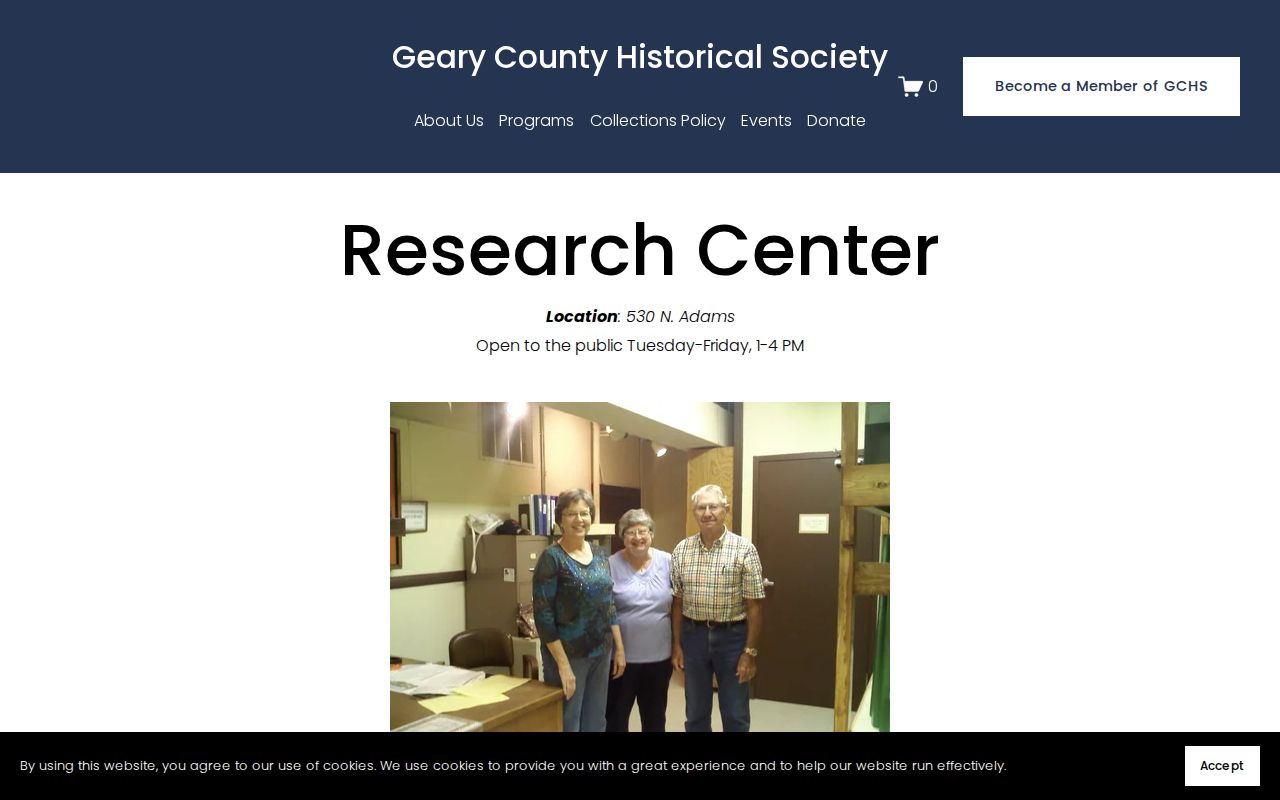
The captured source confirms both the breadth of the collection and the need for exact request details.
Junction City Source Timeline
The timeline shows why a Junction City city directory should be paired with sources from the same period. It does not claim that a directory appeared in every year.
| 1855-1888 | Search Davis County as well as Junction City and later Geary County names. |
|---|---|
| 1898-1900 | A Missouri Kansas Telephone Company subscriber-list lead includes Junction City; verify the exact page and fields. |
| 1905 and 1912 | Catalog leads identify Junction City city directories for these years. |
| 1959 and 1961 | Polk’s Junction City City Directory issues are cataloged. |
| 2007-present | The library Community Information Directory tracks more than 350 local and regional organizations. |
Geary County carried the Davis County name until March 7, 1889. Early newspaper, deed, church, census, and election searches should include that older jurisdiction label. Junction City itself also used earlier settlement names, so a very early place search may need Manhattan, Millard City, or Humboldt in the source query.
Junction City Civic Directory
The library Community Information Directory has been published since 2007 and contains more than 350 local and regional organizations. It is not the same kind of city directory as a Polk volume. Its entries document civic groups and current contact routes, not private household membership.
Use the edition date and verify the organization’s current contact before relying on an entry. The directory is useful for tracing clubs, churches, service groups, and community institutions named in an older newspaper or yearbook. Do not infer that a person belongs to a group merely because an address or surname appears elsewhere.
Trace Junction City Family Years
City directories fill the years between census snapshots. The strongest household trail uses each dated source for the narrow fact it can prove, then records any conflict instead of smoothing it away.
- Locate the earliest cataloged Junction City edition likely to contain the surname. Verify the actual page, publisher, and year.
- Transcribe the name and address exactly. Save the abbreviation key and note all uncertain marks.
- Check the same person in the next available city directory year and record each change in address or printed role.
- Pair directory years with the 1905 Kansas census, federal census images, and KSHS street-address indexes where dates align.
- Search the library newspapers and yearbooks for the same name, street, school, club, or business, citing title, date, and page.
- Use maps, deeds, and the historical society only for the additional land, building, or family facts they actually document.
A missing name can mean a gap in the run, a spelling change, an unlisted household, a move, a death, or limits in the digital index. It is not proof by itself. For a modern name that needs separate official verification, move to the resident lookup workflow rather than forcing a historic source to answer a current question.